
The Rehearsal Room: Virtual Stores for Retail Training
Walk into any two branches of the same retail chain and you will likely spot the differences. A promotional end cap sits at eye level in one store and at knee height in another. Point-of-sale materials face the wrong direction. Shelf facings have drifted a few centimetres off the planogram. None of it is deliberate. The teams on the ground followed the same instructions. They just interpreted them differently.
That gap between what head office envisages and what shows up on the shop floor is one of the most expensive problems in Australian retail. According to the Promotion Optimisation Institute, seventy per cent of companies report ongoing struggles with compliance and in-store execution on retailer-aligned promotions. McKinsey research puts the stakes even higher, finding that retailers who achieve execution excellence outperform competitors and deliver two to three times more shareholder value. In a grocery sector worth close to $200 billion a year, and with nearly 9,640 supermarkets and grocery stores spread across the country, the compounding cost of inconsistent execution is staggering.
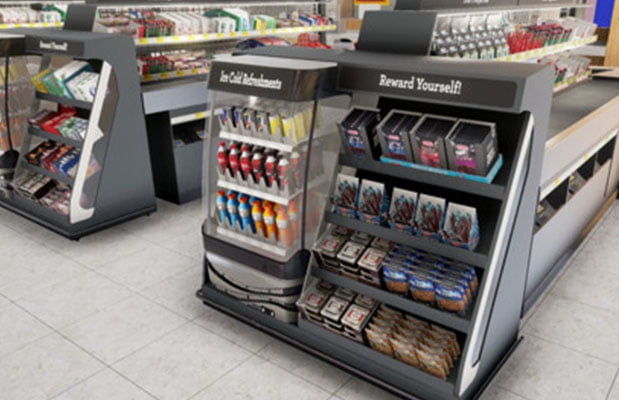
The underlying challenge is not a shortage of planning. Australian retailers and their FMCG partners produce detailed planograms, campaign briefs and merchandising guidelines in abundance. The breakdown happens in translation. A two-dimensional diagram can specify facings and shelf heights, but it cannot convey how a display should look once a team member stands in front of the fixture, adjusting for differences in store layout, lighting, sightlines and fixture depth. When the reference material is flat, interpretation becomes personal. And personal interpretation, multiplied across hundreds of locations, becomes systemic drift.
From Testing Lab to Training Ground
StoreLab, an Australian virtual retail simulation company with more than 35 years of experience in the sector, sits at the centre of this shift. The company maintains a library of over 40,000 individual 3D product models and more than 150 virtual retail environments, serving clients including some of the country’s largest retailers and consumer goods brands. Its platform spans three distinct functions:
StoreLab Connect gives enterprise teams the ability to walk through, modify and share store layouts digitally, turning static planograms into interactive, three-dimensional references.
StoreLab Research uses proprietary 3D eye-tracking software to capture shopper gaze data in virtual environments, identifying what draws attention and what gets overlooked.
StoreLab FieldForce translates approved layouts into structured walkthroughs for field teams, complete with compliance scoring and geo-tagged photo auditing.
Rehearsing the Reset
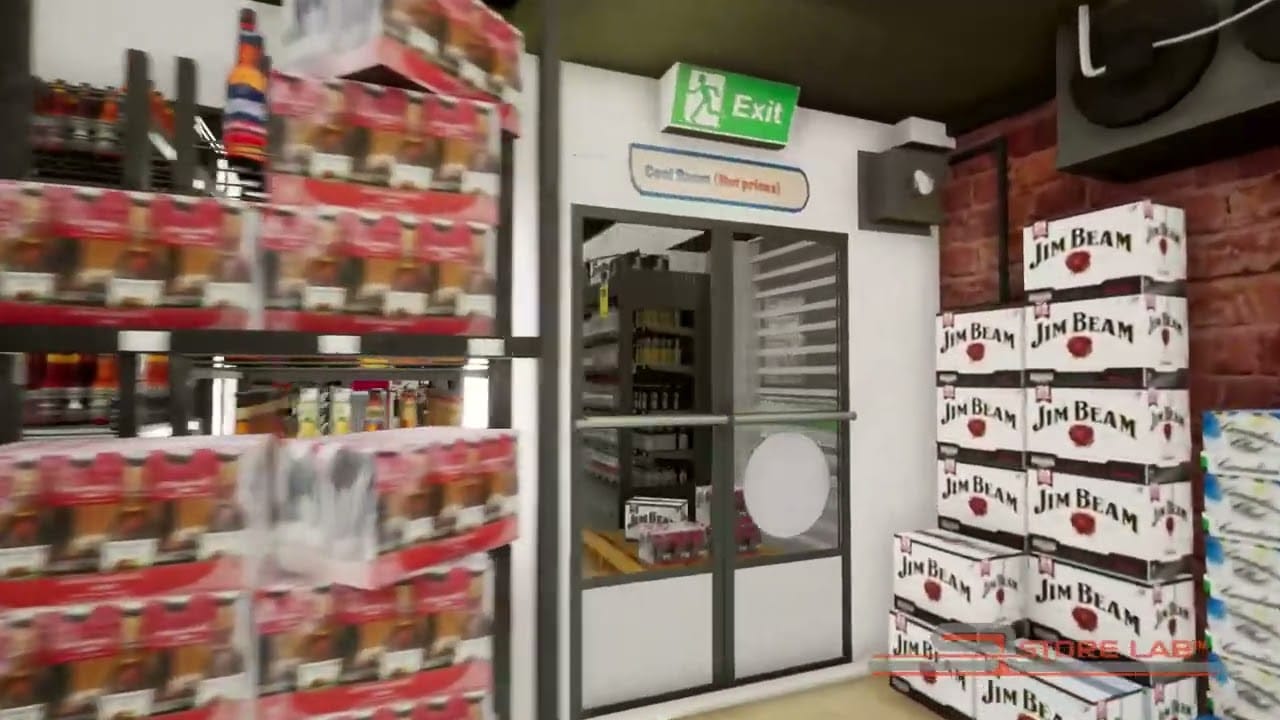
The practical applications vary by role, but the principle is consistent: give people a three-dimensional reference before they start physical work.
How different retail roles use virtual stores
| Role | How Virtual Stores Are Used | Operational Benefit |
|---|---|---|
| Store Manager | Preview new planograms and promotional layouts in 3D before physical setup | Reduces interpretation errors and rework across locations |
| Merchandiser | Rehearse shelf resets and category blocking in virtual environments | Improves speed, consistency and first-time accuracy |
| Field Representative | Review campaign standards and compliance criteria before store audits | Supports more objective, efficient compliance checks |
| Category Team | Visualise proposed changes and gather stakeholder feedback before production | Aligns decision-makers early, reduces costly late-stage revisions |
| National Sales Manager | Create and distribute video walkthroughs with data overlays via StoreLab Storyteller | Turns passive briefs into immersive, scalable training content |
One Store, Many Screens
In a market as geographically dispersed as Australia, the collaboration advantages of virtual stores are hard to overstate. Head office teams in Sydney or Melbourne, creative agencies, packaging designers and field staff spread across regional towns can all review the same digital environment without constructing a physical mock store. The alternative, flying people in to inspect a single prototype setup, is expensive, slow and increasingly difficult to justify when the technology exists to do it from a laptop.
StoreLab’s Storyteller function extends this further by allowing teams to produce video walkthroughs with data overlays and commentary baked in. A national sales manager can record a guided tour of a new campaign layout, annotated with compliance criteria and key performance indicators, and distribute it to every state manager in a single afternoon. The format turns a passive brief into something closer to an immersive briefing.
This kind of remote alignment is becoming more important as Australian retailers operate under tighter cost structures. Woolworths and Coles, which between them account for the lion’s share of national supermarket revenue, are both investing in distribution automation and store format innovation. The pressure on suppliers and brand partners to execute flawlessly at store level has never been higher. When a major retailer expects a promotional display to look identical across a thousand-plus locations, the margin for interpretation error is vanishingly small.

Training for the Unexpected

Bridging Strategy and Shopfloor
For senior leaders in retail and FMCG businesses, the question is not whether execution matters. Everyone agrees it does. The question is how to close the gap between what is planned in a boardroom and what a shopper encounters in aisle five on a Tuesday afternoon. Traditional approaches, more audits, more documentation, more compliance checklists, address the symptoms without touching the root cause. The root cause is that two-dimensional instructions are an imperfect way to communicate three-dimensional outcomes.
Virtual store technology does not replace field teams, physical stores or the irreplaceable value of experienced merchandisers who know their territory. What it provides is a shared visual language that reduces ambiguity before execution begins. When every person involved in a campaign, from the category manager who approved it to the casual staff member who builds the display on a Friday evening, has walked through the same three-dimensional reference, the chances of consistent delivery improve measurably.
In an Australian retail landscape defined by concentration, cost pressure and increasingly sophisticated shopper expectations, that consistency is not a luxury. It is a competitive requirement. The retailers and brands that treat execution as an engineering problem, one that can be rehearsed, measured and improved through better tools, will be the ones that extract the most value from every dollar spent on planograms, campaigns and in-store marketing.
The smartest operators are no longer waiting until the shelves are stocked to find out whether the plan worked. They are rehearsing first.
Further Reading
Stock-Outs Cause Walkouts (Harvard Business Review). A foundational global study of 71,000 consumers by researchers Daniel Corsten and Thomas Gruen, demonstrating that up to 43% of shoppers will abandon a retailer for a competitor when encountering an out-of-stock item. Read here.