

A retail store design brief is a decision record, not a wish list

A retail store design brief should settle the business outcome, shopper missions, range and service model, operational limits, format rules, decision owners, and capital boundary before design begins. Those are decisions, not preferences. When they stay open, the design team ends up guessing at them, and the guesses surface later as layouts another part of the business rejects.
That is where most store design rework comes from. Not from weak design, but from a brief that looked finished and left the hard trade-offs unmade. A concept clears the room, then falls apart when the range will not fit the floor, the collection point lands in the checkout queue, or the flagship logic collapses in a smaller format. By then the fitout budget is usually committed.
A brief earns its keep when it records what has already been decided, who decided it, and what evidence sits behind each call. It gives the designer a defined problem to solve, and tells every approving team which assumptions are settled and which are still open.
Which business outcome should the design deliver?
The brief should name one primary outcome and show how competing ones will be handled. Growth, faster service, product discovery, format renewal, category expansion, and lower operating cost can all shape a store design. They rarely point to the same layout.
Take a retailer expanding a service counter while trying to shorten queues. More service space can improve advice and collection. It can also reduce selling space or block a sightline to a destination category. The brief has to say which outcome wins when the design cannot do both.
A workable way to record it:
- Primary outcome: the main commercial or operational change the project has to support.
- Secondary outcome: a benefit worth pursuing where it does not weaken the main goal.
- Protected condition: something the project must not damage, such as service capacity, category visibility, or replenishment flow.
- Evidence measure: the data or observation used to judge whether a design supports the goal.
The point is to compare design options against agreed outcomes, not against taste. Sales still depend on the offer, execution, location, and demand, so the brief sets direction rather than promising a number.
Which shopper missions does the store need to serve?
One broad “customer journey” hides the differences that actually shape space. A brief needs several defined missions. A planned weekly shop, a quick top-up, a discovery trip, and an order collection might share a front door while needing different paths and service points.
For each mission, the brief should describe the moments that matter:
- Entry and orientation: what the shopper needs to grasp in the first few steps.
- Navigation: which destinations must be easy to find, and which areas should invite browsing.
- Selection: where comparison, advice, or trial is needed.
- Service and fulfilment: how queues, counters, collection, and returns fit the path.
- Payment and exit: where congestion or cross-traffic is likely.
A mission should be concrete enough to draw. “Convenient shopping” is not. “Collect an online order without crossing the main checkout queue” is, because it gives the design team something to test.
Which operational limits should be locked before design?
Operational limits are the conditions the store works within every day. Fix them, or mark them clearly as assumptions, before design starts. Otherwise a strong-looking layout can fail during replenishment, peak service, cleaning, or stock handling.
The brief should cover:
- Staffing and service model: where staff stand, which tasks need line of sight, and how assisted service shifts through the day.
- Replenishment and back-of-house: delivery access, stock routes, holding areas, and when replenishment can happen.
- Security and loss prevention: protected stock, staff visibility, and any controlled-access areas.
- Accessibility: the design requirements and specialist advice for the site and store type.
- Storage, cleaning, and maintenance: access that has to stay clear once fixtures, screens, and queues are added.
- Technology: power, data, screens, devices, and collection points.
Compliance detail varies by site and jurisdiction. The brief should name which specialist owns each requirement and when it has to be confirmed, rather than treat it as already settled.
What stays consistent across store formats?
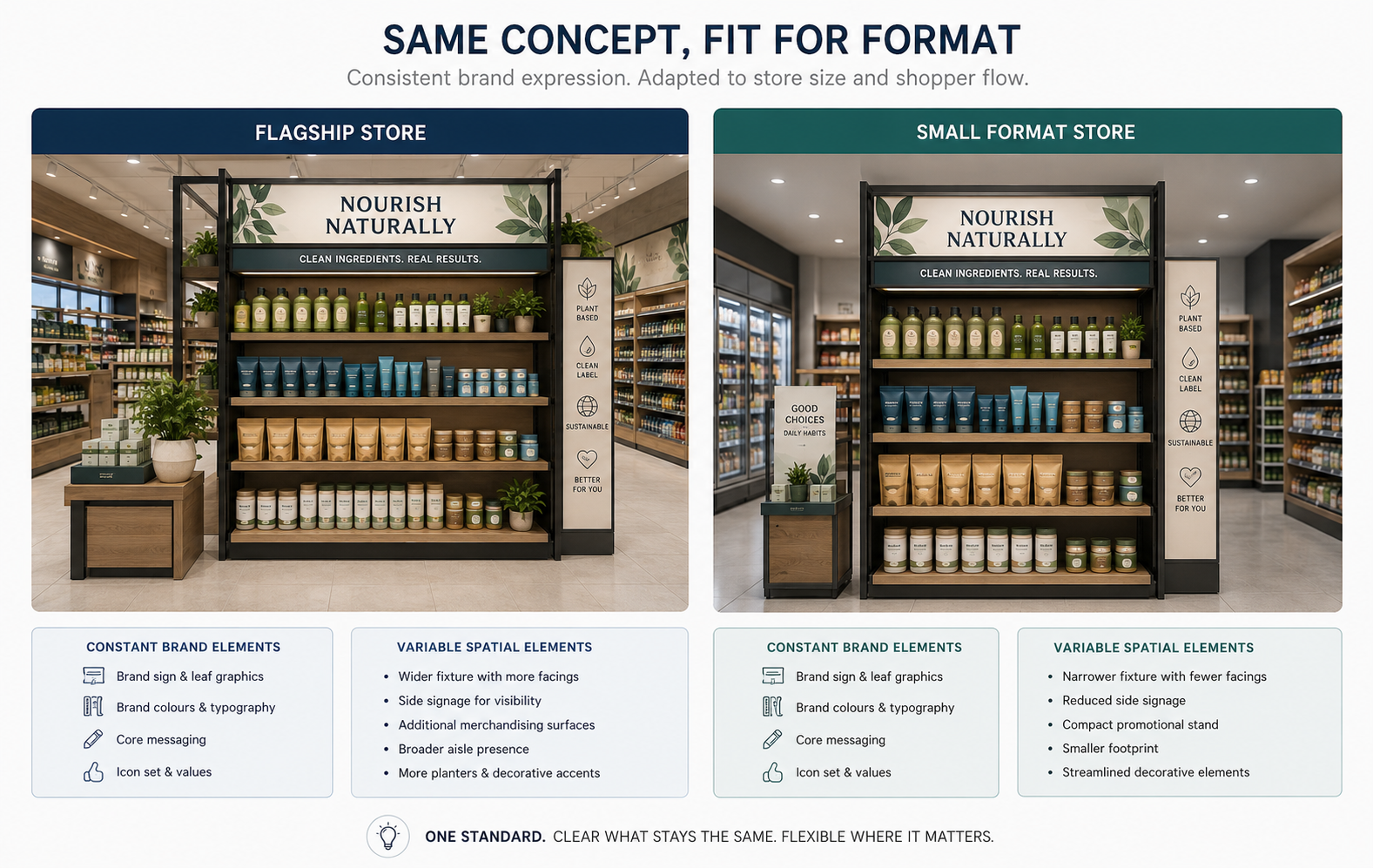
A multi-format brief should separate the brand and service constants from the parts that can change with store size, location, range, or mission. Treating every store as a shrunken flagship tends to produce crowded layouts and service zones that do not work at smaller scale.
| Must stay consistent | Can vary by format |
|---|---|
| Brand promise and key visual cues | Fixture count, bay count, and range depth |
| Core service principles | Size and location of service areas |
| Category logic and orientation cues | Adjacencies where space is tight |
| Required customer and staff information | Signage scale and local messaging |
| Minimum access and operating conditions | Fulfilment footprint and storage allocation |
| Approval rules and design governance | Materials and details suited to the site |
The brief should also name the reference format. A flagship can show the full concept, but it should not be the only store used to judge whether the design scales.
Who owns each decision in the brief?
Clear decision rights stop a project reaching late review with ownership still unresolved. Each major decision needs one accountable owner and a defined point where it is approved. Contributors inform the call; they do not carry it.
| Decision | Accountable owner | Approved before |
|---|---|---|
| Business outcome and investment case | Commercial leadership | Concept work |
| Range and category role | Category or merchandising | Layout options |
| Shopper missions and service model | Retail operations | Zoning |
| Store design and format rules | Store design lead | Detailed design |
| Technology and fulfilment | Technology or digital lead | Services coordination |
| Final capital approval | Finance or capital committee | Fitout commitment |
Insights or research can own the evidence without owning the decision. Store teams can add practical operating knowledge without carrying enterprise approval. Making those roles visible keeps consultation from turning into shared accountability with no final owner.
How does store design visualisation expose conflicts?
Store design visualisation turns the written brief into a spatial model the team can walk, from both the shopper and the operator side. It is most useful when a brief looks complete on paper but holds decisions that cannot share the same space.
A visual review tends to surface:
- A promotional fixture blocking the sightline to a destination category.
- A range that only fits by narrowing circulation or service space.
- A queue crossing the main path at peak.
- A collection point where waiting customers meet replenishment movement.
- Screens, fixtures, or equipment competing for the same wall, power, or access point.
- A flagship concept that loses its logic in a smaller format.
Tools such as Storelab Connect let teams build interactive store layouts, adjust planograms, run walkthroughs, and save versions, so competing readings of the brief can be compared side by side. The model is a way to validate decisions, not to make them. Architects, designers, operations leads, compliance specialists, and capital owners keep their own responsibilities.
What belongs in a pre-design checklist?
A pre-design checklist should show whether each input is approved, assumed, or still open. The design team should not have to infer status from meeting notes or slide comments.
| Brief item | Status needed before design |
|---|---|
| Objective, with the priority outcome named | Approved |
| Store format and site conditions | Approved |
| Shopper missions | Approved |
| Range and category role | Approved, or controlled assumption |
| Service, collection, returns, and payment | Approved |
| Operations: staffing, stock, cleaning, maintenance | Approved |
| Technology: screens, devices, power, data, access | Approved, or named assumption |
| Capital boundary | Approved |
| Decision owners | Named |
| Evidence base | Attached or referenced |
| Format variants: constant versus variable | Defined |
| Approval gates | Agreed |
Do not issue the brief as a fixed file and then let decisions keep moving elsewhere. Keep a decision log beside it, recording the owner, date, evidence, and effect of every material change. That gives the design team a current brief they can trust, and gives later reviewers a record of why the design changed.
Before fitout costs are committed, review the brief across commercial, category, operations, technology, finance, and design together. This is the point where a virtual model earns its place. Storelab can turn an approved brief into a store you can walk and test before any fitout spend, so a blocked sightline or a crossing queue shows up while the decisions can still change.