


What is planogramming? The meaning, and what a planogram has to get right
Planogramming means deciding where every product in a range sits on a fixture, then writing that decision down so every store builds the same shelf. The document it produces is the planogram: shelf by shelf, product by product, with positions, facings and neighbours set out. The word covers the decision and the document, not the work of filling the shelf.
What is planogramming?

Planogramming is the process of deciding where each product in a range sits on a fixture. The decision is recorded, then issued to stores so they all build the same shelf. A fixture is the run of shelving a category lives on. One bay is one section of it.
The word covers two things, and only two. There is the decision about position, and there is the document that carries it. Filling the shelf is a separate job. It is done in the store, with a trolley of stock in front of the bay.
It is not store layout either. Store layout decides where whole categories sit, and how a shopper moves between them. Planogramming starts after that. It works on one fixture at a time, with the range already chosen.
It has a place in the calendar. The range decision comes first, and says which products the category will carry. Planogramming follows it. The plan is issued before a reset, which is the day the shelves are physically rebuilt. What the store team works from is the output of this process, not the range decision behind it.
What is a planogram?
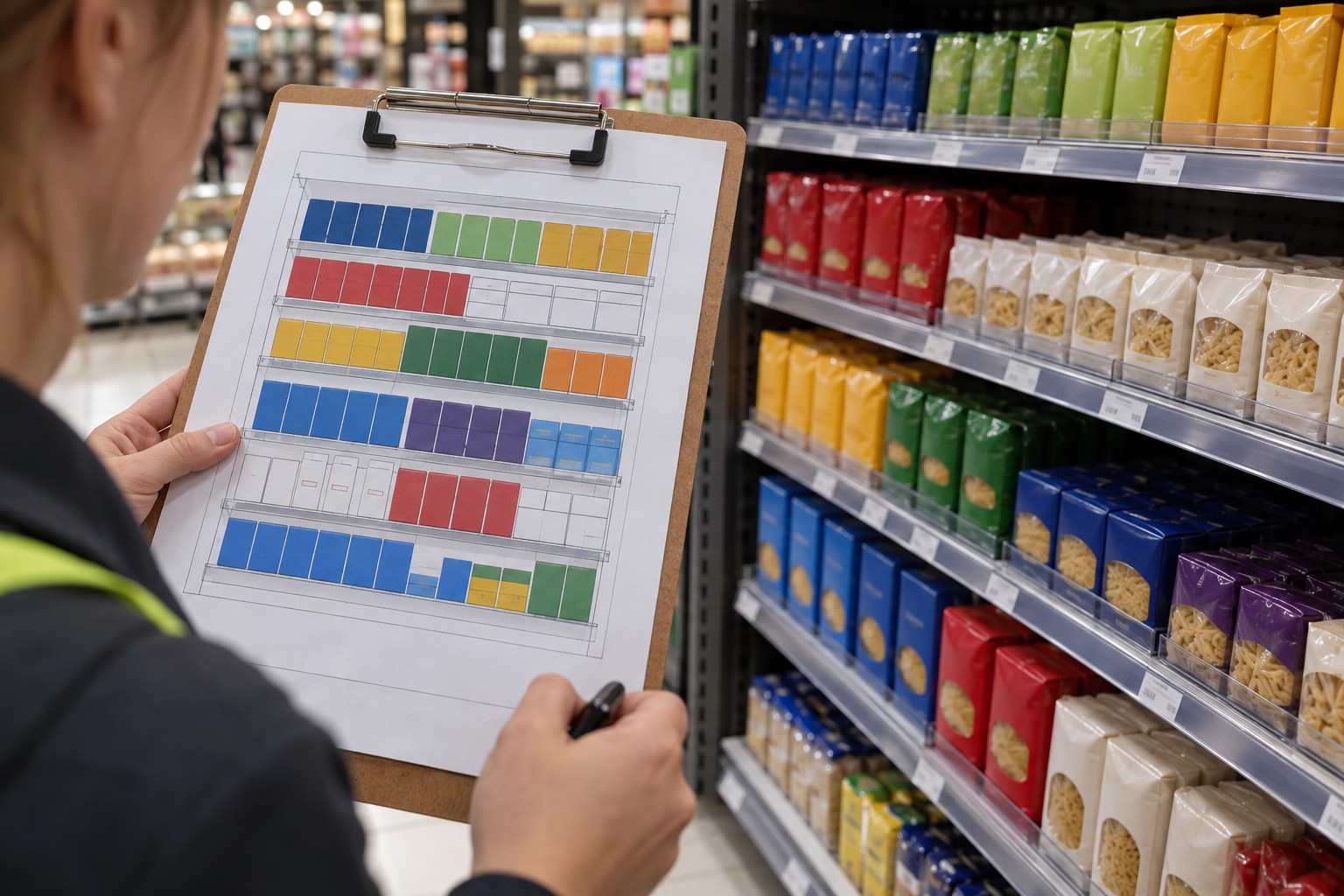
A planogram is the document that records the decision. Four things are on it. Which products are in, where each one sits, how many of each is visible at the front, and what sits next to what.
A facing is one unit of a product visible at the front of the shelf. Two facings means the shopper sees two of them side by side. Adjacency is what a product sits beside, above and below. Both are decisions rather than accidents.
A planogram is drawn against one named fixture, using that fixture’s real dimensions. The width of the bay, the number of shelves and the gap between them all sit behind the drawing. A plan drawn against a fixture no store has is a picture, not a plan.
It usually starts in space planning software and travels as a file. A .psa planogram file is one common format. Printed, it looks like a flat view of the bay, with every pack drawn in its place.
Two things a planogram is not. It is not a range list, which says what the category carries and nothing about position. It is not a photo of a finished shelf, which shows what one store did on one day.
A retail planogram exists for one commercial reason. The shelf a shopper finds in one store should be the shelf they find in the next one.
Planogram meaning: planogram, planograms, POG and the rest

Planogram, planograms, plan-o-gram, POG, schematic and plan all name the same document. The variation is habit rather than meaning. POG is the initials said aloud, and it is what many category teams say day to day.
People search planogram meaning and planograms meaning. Both questions are asking the same thing.
The dictionary settles the noun. Merriam-Webster lists planogram as a noun. It defines one as ‘a schematic drawing or plan for displaying merchandise in a store so as to maximize sales’, in that source’s own spelling. It gives the first known use as 1986.
The process word is harder to pin down, and there is a plain reason for that. Merriam-Webster has an entry for planogram and no entry for planogramming. The noun has settled into general use. The process word is still trade vocabulary. That is why the definitions you find for it disagree with each other.
Software makers use the process word as a verb. A space planning tool will describe an automated planogramming step inside it, meaning the software drafts the diagram rather than a person.
One distinction is worth keeping straight. Space planning is the wider discipline. It covers how much space a category gets, and how that space is managed across a network. A planogram is one output of it. The companies that sell space planning software use the words the same way.
The last split is the one people trip over. Planogramming is the process. A planogram is the document. Merchandising is the wider commercial activity around both. Planogram merchandising names the decisions the plan itself owns, and where the plan stops and the presentation starts is worth reading properly, because different teams lead them.
Who makes a planogram, and from what

A planogram is made centrally, by a few people, for a lot of stores.
A category manager owns the category and the range inside it. A space planner builds the plan and knows the fixtures. On the supplier side, an account manager or category development manager puts a case for their products. They often bring a version of the bay they have built themselves.
Four things go in:
- The range decision, which says what the category will carry.
- Rate of sale, which is how many units a product sells in a store in a week.
- Fixture drawings and dimensions, for each format the plan has to fit.
- The retailer’s own merchandising principles, which set the rules the plan has to follow.
The retailer signs the plan off. The people who receive it are store teams, and often a third party doing the reset overnight. Those are two different audiences. The second one has to build the thing with nobody to ask.
What a planogram has to get right to survive a store

Most of the stores that build a plan are never visited by the person who wrote it. Everything in this section follows from that.
The document has to be complete. It has to name the fixture it was drawn against. It has to be exact about what goes where, and about how many. The person building it works from the page, with a trolley of stock beside them and a shift to finish. Anything the document leaves open gets settled on the night, by someone guessing.
A plan can be correct and still be impossible. The range can be right. The order can be right. The facings can be right. The plan can still not fit half the stores. Correct and buildable are two separate tests, and usually only the first one is checked.
Store formats vary across a network. That is a fact about networks rather than a fault in the plan. One document issued unchanged to a large store and a small one will fit the first and not the second. The stores that cannot build it look non-compliant, for a reason that has nothing to do with effort.
One plan, one fixture, one version. A plan that exists in three versions in three inboxes has stopped being the thing stores are meant to build. The document has to be the single answer to what this bay looks like.
That is also why a plan carries a version and a date it applies from. Without both, a store cannot tell whether the sheet in their hand is the current one.
What happens to a planogram before it reaches stores

A plan can be built and walked before it is issued, rather than seen for the first time on reset night. That is the step this section describes.
The file the space planner produced is opened, and the bay is stood up at full size. Someone walks it the way a shopper would. The people who have to approve it see the bay at the size it will exist at, instead of on an A3 print.
Shoppers can be put in front of it too. What comes back is narrow and useful. It is whether the product people are meant to find is found. That is measured in a simulated store, with eye tracking in a headset, or as an online simulated shop with a survey afterwards.
Once the plan is in stores, the loop closes the other way. What was issued is compared with what the store built, using photographs and a rating done by a person in the aisle. Those ratings build up across territories, so the picture is of the network rather than of one store.
This step answers one question at a time. What a retailer examines when it tests a planogram is broader than that, and it is a subject of its own.
A planogram leaves one desk and lands in every store on the list, and no two of those stores are quite the same. What happens to a plan after it ships is a separate story, and a useful one to read before the next reset. The gap between the desk and the shelf is not a fault to be fixed. What can change is how much is known about those shelves before the document goes out.
Bring one planogram and the two store formats it has to work in. Storelab will stand it up at full size and walk it with you before you issue it. You will know which of the two formats it fits, and what has to change for the other.
Frequently asked questions
What does planogramming mean?
The word describes a piece of work rather than a thing on a shelf. Someone settles the position of every line in a category, and issues that settled position as a diagram. If a store team is building to a diagram, planogramming is what produced it.
Is a POG the same as a planogram?
Yes, the two words point at the same diagram. Swapping one for the other changes nothing about what the store has to build. The short form is simply quicker to say in a meeting.
Who writes the planogram, the retailer or the supplier?
It is the retailer’s document. A category manager and a space planner put it together between them, working from range and sales data. A supplier can build their own version of the bay to argue for a change, but the final call belongs to the retailer.
Why does the same planogram work in one store and not in another?
Because the two bays are not the same. A layout drawn for one fixture may not fit the fixture the second store has, and the team there ends up improvising. The mismatch starts in the document, not on the shop floor.