
Shelf planning vs planogram software at scale
A head of category can usually tell when shelf planning has outgrown the process supporting it. The signs are familiar: the same space arguments returning each review cycle, inconsistent execution across store formats, supplier proposals reshaping category intent without a clear framework to evaluate them against. The planning output looks complete. The underlying commercial tensions haven’t been resolved.
That gap is what makes the shelf planning vs planogram software comparison worth taking seriously. From the outside, it looks like a tools question. Inside a large retail organisation, it forces a harder conversation about how category decisions are governed across formats, stores and review cycles.
Where shelf planning holds up and where it falls short
Shelf planning as a practice covers a wide spectrum. At its simplest, it means mapping products to available space. At its best, it means working through trade-offs in range, facing, adjacency and segment logic before anything reaches a store.
Most large retailers sit somewhere in between. The gap between teams is often wider than leadership realises.
Common signs that planning is under strain at scale:
- Category reviews that produce layouts but defer trade-offs. The output looks settled, but the commercial tensions (range depth vs facing count, brand logic vs segment logic, supplier pressure vs shopper flow) haven’t been worked through.
- The same space debates returning cycle after cycle. If a category argument keeps resurfacing, it usually means the previous decision wasn’t governed well enough to hold.
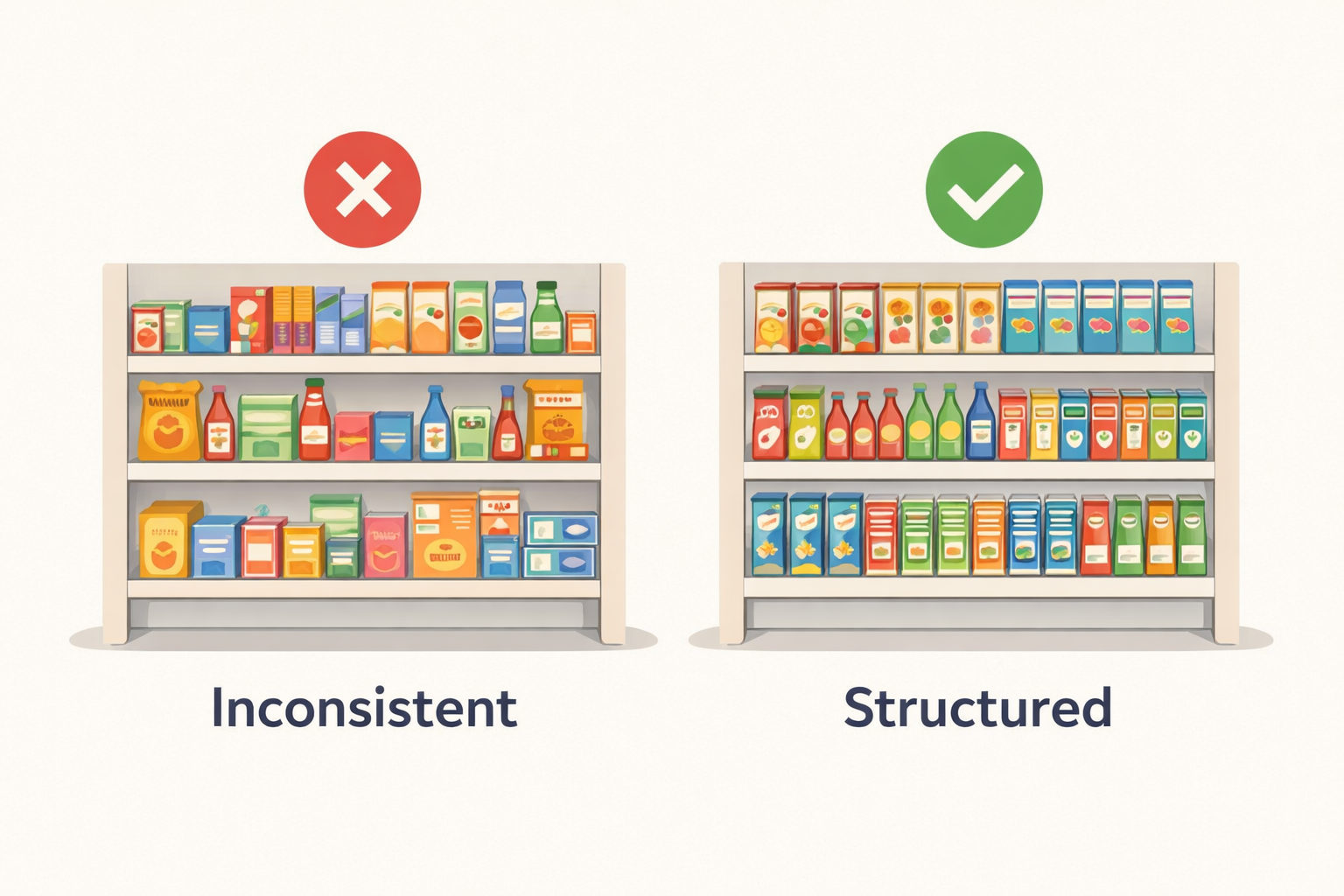
- Inconsistent translation from head office to store. A plan that works on screen at head office doesn’t always survive contact with a 450 sqm store in regional Queensland or a high-traffic metro format in inner Sydney.
- Exceptions overtaking the standard. Local adjustments, supplier-funded changes and promotional carve-outs accumulate until the original category intent is hard to recognise.
- Late operational objections. When field teams or store operations raise problems after sign-off, it usually means they weren’t part of the planning process early enough, or the planning tools didn’t make execution realities visible.
None of these failures are dramatic on their own. Across a network of 500 or 900 stores, they compound into material commercial drag.
What planogram-led planning changes in practice
The shift from general shelf planning to planogram-led planning is often described in technical terms: better visualisation, more precise product placement, tighter data integration. That framing undersells the real change.
What planogram software does at enterprise scale is introduce a governed planning layer. Category decisions move from being recorded in files and presentations to being managed within a system that supports comparison, version control, format variation and cross-functional review.
In practical terms, that changes several things at once:
- Trade-off visibility improves. When space decisions are structured within a planogram environment, it becomes harder to approve a layout without confronting the commercial consequences. This is where deeper testing frameworks come into play (as outlined in what retailers actually test when they test a planogram), ensuring decisions hold up beyond initial review.
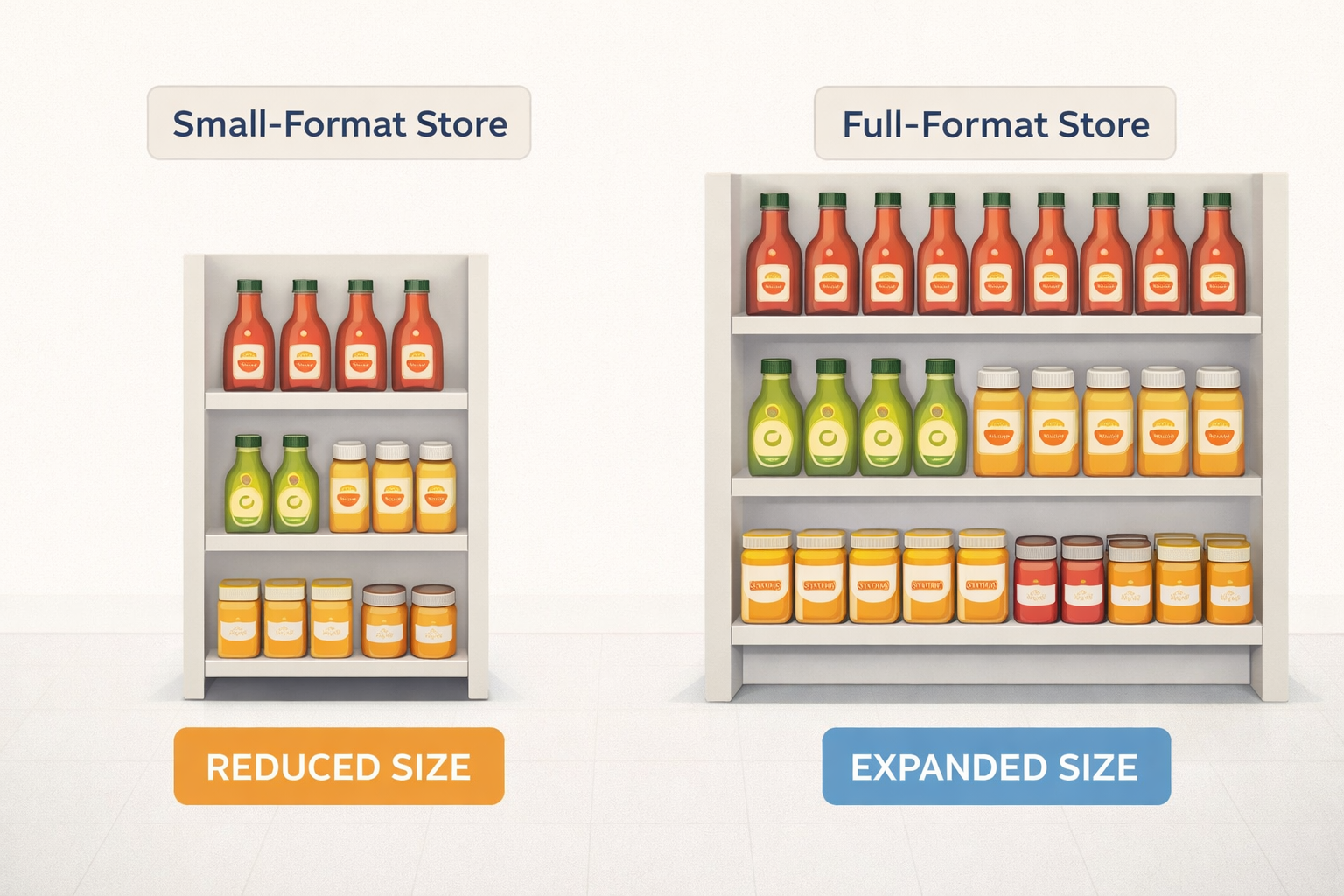
- Format-specific planning becomes manageable. A retailer running three or four distinct store formats (think the difference between a Woolworths Metro, a full-format suburban store, and a regional supermarket) needs a way to plan each format against the same category logic without starting from scratch each time. Planogram software makes that practical, particularly when teams can review layouts across formats in a shared, visual environment using tools like Storelab Connect.
- Consistency becomes auditable. Leadership can see whether stores are executing the agreed plan or drifting. Field teams have a clearer reference point. Compliance tracking shifts from anecdote to evidence.
- Supplier conversations get more structured. When a supplier proposes a range or space change, the category team can evaluate it against the existing planogram rather than against a general sense of what the shelf looks like.
Two approaches compared
| Basic shelf planning | Planogram-led planning | |
|---|---|---|
| How decisions are recorded | Spreadsheets, PDFs, presentation slides | Structured planogram files with version history |
| Format variation | Often handled as one-off adjustments | Managed through format-specific planogram sets |
| Cross-functional review | Circulated documents, meeting-based approval | Shared environment with visual review capability |
| Consistency tracking | Manual field checks, photo audits | Systematic comparison of planned vs executed |
| Supplier negotiation basis | Works for a few categories or formats | Specific planogram position and facing data |
| Scalability | Works for a few categories or formats | Designed to support complexity across the network |
The table is deliberately simplified. In practice, many retailers sit at different points for different categories, which is itself a sign that the planning process lacks consistency.
Where the difference shows fastest
Some categories tolerate loose planning for longer than others. The ones that expose it quickest tend to share a few characteristics: high SKU density, tight margin structures, strong promotional pressure, or formats where navigation and visibility directly affect basket size.
| Category type | Basic shelf planning | Planogram-led planning |
|---|---|---|
| Grocery (high-SKU) | Range density and substitution complexity leave little room for imprecise space allocation | Small facing errors compound across hundreds of stores |
| Health and beauty | Segment clarity and brand blocking affect how shoppers navigate the fixture | Space decisions directly influence shoppability and dwell time, which is why many retailers invest in shopper behaviour and visibility testing through Storelab Research before locking in category layouts. |
| Seasonal | Compressed decision windows and fixed floor dates | Planning errors are harder to correct once stock is committed |
| Promo-intensive | Displays compete with permanent range for space and attention | Without governance, short-term activity erodes long-term category structure |
| Convenience and impulse | Displays compete with permanent range for space and attention | Shelf logic needs to support fast decision-making at the fixture |
In Australian grocery and pharmacy retail, where national chains run hundreds of stores across significantly different format sizes, the gap between governed and ungoverned planning tends to show up in execution variance, field correction costs and category review efficiency.
Why software alone doesn’t close the gap
A common pattern: a retailer invests in planogram software, trains the team, produces cleaner outputs, and still finds itself revisiting the same category arguments six months later.
The tool improved the documentation. It didn’t resolve the underlying decisions.
This usually traces back to one or more structural issues:
- No agreed view on category role and space priority. If leadership hasn’t defined how space should be allocated across categories relative to their strategic importance, every review becomes a negotiation from first principles.
- Unclear rules for format variation. Without a framework for what stays fixed across all stores and what flexes by format, every local adjustment becomes a judgement call rather than a governed exception.
- Weak alignment between category, visual merchandising and operations. Planogram software can make the plan visible to all three functions. It can’t make them agree if the organisational incentives pull in different directions.
- Poor product data. Dimensions, hierarchy, imagery and attribute data need to be accurate for planograms to be reliable. Many retailers underestimate how much data cleanup the transition requires.
Senior teams evaluating planogram software should be honest about whether these foundations are in place. The software performs best when the organisation has already committed to a governed planning approach. It performs worst when it is expected to substitute for one.
Questions worth asking before changing the approach
Before committing to a platform change, senior retail teams benefit from testing whether the organisation is ready for what planogram-led planning demands.
A practical internal check:
- Are category reviews producing resolved decisions, or are they producing presentations that defer the hard calls?
- How often do the same space allocation arguments return in the next cycle?
- Can the business explain why each category segment holds the space it holds?
- Do stores execute the agreed layout consistently, or does every store look slightly different for reasons nobody can fully articulate?
- Are supplier proposals evaluated against a structured framework, or do they succeed based on commercial pressure and relationship?
- Can current tools support meaningful comparison across formats?
- Are field teams and store operations involved early enough in the planning process?
These questions matter more than a feature comparison between software platforms. They reveal whether the organisation is ready to use the tool well or likely to recreate its existing problems in a more expensive environment.
The line between recording and governing
Every retailer that reaches a certain scale faces the same transition point. Shelf planning that started as a practical exercise in fitting products to space eventually needs to become something more systematic.
Planogram software supports that transition. It gives category teams a structured way to plan, review, compare and govern space decisions across formats and stores. It makes trade-offs visible, supplier conversations more evidence-based, and execution more auditable.
The commercial value, though, sits in the governance shift itself: moving from documenting where products go to actively governing why they go there, and holding that logic together from head office through to the shop floor.
Frequently asked questions
What is the practical difference between shelf planning and planogram software?
Shelf planning is a general term for deciding how products are arranged in retail space. Planogram software is a more structured system that supports detailed layout management, format variation, version control and consistency tracking across stores. The distinction matters most at scale, where the complexity of managing multiple categories, formats and stores makes a governed process more commercially valuable than an informal one.
Is planogram software only relevant to grocery retailers?
No. Any retailer where space allocation, product visibility, assortment management and store execution affect commercial performance can benefit. This includes health and beauty, pharmacy, convenience, specialty retail and department stores. The common factor is that the category is complex enough for ungoverned planning to create material inconsistency.
Why do some retailers still struggle after investing in planogram software?
Usually because the software was expected to fix problems that sit upstream of the tool: unclear category strategy, weak governance frameworks, poor product data, or misalignment between category teams, visual merchandising and operations. The software improves planning infrastructure. It doesn’t replace the strategic decisions that make the infrastructure useful.
Does moving to planogram-led planning reduce commercial flexibility?
In most cases it increases useful flexibility. A governed framework makes it clearer which elements should remain consistent across the network and which can vary by format or local conditions. Without that clarity, flexibility tends to mean inconsistency. With it, exceptions become intentional and trackable.
How do Australian retailers typically approach this transition?
Australian retailers operating national networks, particularly in grocery, pharmacy and discount retail, tend to hit the transition point when format variation, store count and category complexity make lighter planning methods unreliable. The specific pressure often comes from execution variance across stores, the cost of field corrections, and the difficulty of running consistent category reviews across formats that range from under 500 sqm to over 4,000 sqm.
What should a senior retail team evaluate before changing planogram tools?
Focus less on feature lists and more on organisational readiness. Key questions include whether category roles and space priorities are clearly defined, whether rules for format variation exist, whether product data is accurate enough to support planogram reliability, and whether category, VM and operations are aligned on how the tool will be used in practice.