
How Retailers Are Using VR to Prove Campaign Compliance and Shopper Impact to Improve ROI
The Pressure to Prove What Works
Across Australia’s retail sector, marketing budgets are under heavier scrutiny than ever. Every dollar spent on in-store campaigns, seasonal promotions or category resets must now be justified with measurable returns. Yet for many chains and FMCG brands, the question remains unanswered: how much of what is planned at head office actually happens in-store?
Retail campaign execution has become increasingly complex. Frequent staff turnover, competing supplier priorities, and inconsistent store formats make it difficult for marketing and operations teams to maintain compliance. The result is costly campaign leakage: posters not displayed, shelves incorrectly stocked, or point-of-sale (POS) materials placed in the wrong location.
Virtual reality (VR) retail research is changing that equation. It allows retailers to test, validate and monitor campaign performance long before launch, providing measurable evidence of shopper impact and compliance. StoreLab has become one of the leaders in this shift, combining VR research, shopper analytics and field execution to close the gap between strategy and reality.

The Compliance Challenge: Proving What Happens In-Store
Campaign compliance refers to the degree to which stores implement marketing, merchandising and promotional activities as intended.
- It covers everything from display placement and product adjacency to staff training and signage consistency.
- When compliance drops, return on investment quickly erodes.
Traditional verification methods like manual audits, mystery shoppers and photographic checks are labour-intensive and inconsistent. This is because:
- Human bias can distort results
- Travel and coordination costs make national campaigns difficult to monitor. According to the Australian Retailers Association, compliance gaps can drain millions in lost sales annually, particularly for short-term activations.
- Retail execution errors remain one of the top operational pain points for multi-site chains. Many campaigns fail not because of poor creative work but because the final execution in-store doesn’t match the planogram or timeline.
The need for accurate, scalable and objective compliance verification has become a strategic priority. Retailers are now looking for technologies that can replace fragmented reporting with reliable, data-driven measurement across every store format and region.
VR in Retail: From Concept to Compliance
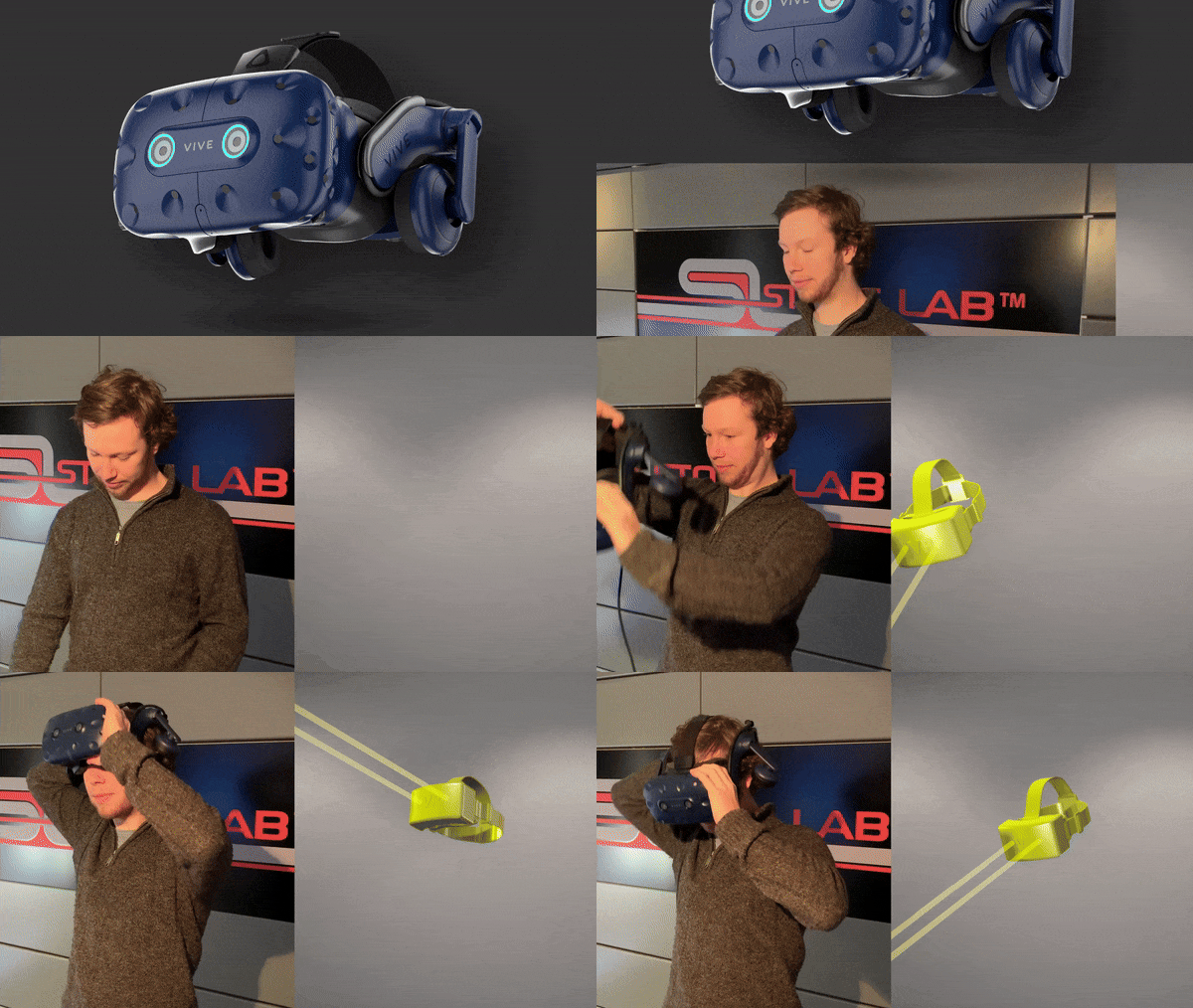
Virtual reality research offers a practical, scalable solution. It recreates the in-store environment in a controlled digital simulation, allowing marketers to test campaign elements before rollout. StoreLab’s virtual store environments replicate real shelf layouts, aisle configurations and shopper pathways with remarkable accuracy.
Here’s how they work:
Every glance, pause and product interaction is recorded.
StoreLab integrates this behavioural data with post-shopper surveys to understand both the emotional (System 1) and rational (System 2) drivers of purchase decisions. This dual-system approach gives retailers a more complete picture of shopper psychology.
Because VR environments are fully controlled, tests can be repeated under identical conditions, which is something impossible in live stores.
The results are statistically robust and can be applied across multiple markets.
How VR Measures Shopper Impact
One of VR’s strongest advantages is its ability to visualise shopper behaviour in detail that traditional research cannot match. Using head-mounted eye-tracking, StoreLab captures fixation points, heatmaps and dwell time across displays. Analysts can see exactly which packaging elements, colours or claims attract the most attention.
Simulated navigation allows participants to move through a virtual store just as they would in real life. Researchers can measure route choices, detours, and the impact of secondary displays on path-to-purchase. Purchase behaviour, including product selection and time to decision, can be tracked at scale.
The insights are immediate. Retailers can compare alternative layouts side by side, identify the best-performing creative elements and validate them before a national launch. Adjustments that once took months of physical prototyping can now be made in days.
VR-based studies can produce results comparable to physical stores while offering greater flexibility and lower cost. StoreLab’s application of these principles within the Australian retail environment gives brands the same scientific precision with local context.

Proving ROI with Virtual Campaign Testing
The core value of virtual retail research lies in its ability to demonstrate return on investment with measurable evidence. Each campaign can be evaluated for uplift in product engagement, brand recall and purchase intent. These metrics translate directly into sales forecasts and budget justification for executives.
StoreLab’s approach enables rapid A/B testing of creative concepts and merchandising layouts. For example, two versions of a seasonal display can be tested to determine which one captures more attention or drives higher conversion. Shopper heatmaps and survey feedback quantify the difference, guiding investment decisions before rollout.
Virtual campaign testing helps retail teams to:
- Measure shopper response early. Assess engagement and recall before any materials are printed.
- Compare alternative designs. Test multiple POS layouts, packaging styles or signage messages in controlled conditions.
- Validate assumptions. Confirm which campaign elements actually influence purchase intent.
- Optimise investment. Identify the combination of visual, messaging and placement factors that deliver the highest ROI.
- Reduce waste. Eliminate the cost of producing or distributing ineffective displays.
The insights are immediate. Instead of waiting for post-launch audits, marketing and insights teams can identify weak points in creative or execution before a campaign goes live. Adjusting shelf messaging, visual hierarchy or pricing signage early reduces production waste and increases confidence in the final design.
For head office teams, this evidence becomes a persuasive tool in budget meetings. It shifts campaign evaluation from subjective judgment to a data-backed ROI narrative that aligns marketing, operations and finance under one set of measurable outcomes.
Why Virtual Testing Beats Traditional Methods
Aspect | Traditional Audits / Mystery Shopping | Virtual Retail Research (StoreLab) |
Scalability | Limited by manpower and travel | Global reach, unlimited respondents |
Accuracy | Subjective, dependent on human interpretation | Objective behavioural data from eye-tracking |
Speed | Weeks or months for results | Insights within days |
Cost | High cumulative expense | Lower cost per test at scale |
Consistency | Inconsistent store conditions | Controlled, repeatable environments |
Predictive Value | Post-launch only | Pre-launch simulation and validation |
Research from Harvard Business Review first identified virtual shopping as a “breakthrough in marketing research” almost three decades ago. Today, advances in hardware and cloud computing have made it practical and affordable for everyday retail operations.
Unlike traditional audits, VR provides consistent measurement across every iteration of a campaign. It eliminates field variability and captures data that can be benchmarked across multiple activations. This consistency improves long-term learning and supports more confident decision-making.
How can retailers use Virtual Research for higher ROI?
The practical applications of virtual retail research extend across every stage of the retail marketing process.
- FMCG Product Launch Testing
A beverage manufacturer can use StoreLab to test new packaging and shelf messaging before release. By measuring shopper visibility, recall and purchase intent, the brand can refine its design to maximise standout in a crowded category. - Retail Format Optimisation
A multi-site retailer planning a new store layout can simulate various aisle configurations. VR data helps identify which layout encourages longer dwell time or higher category engagement. Insights are then used to train staff and brief contractors. - Campaign Compliance Validation
After launch, StoreLab’s FieldForce platform allows retailers to verify that execution matches the approved virtual model. Geo-tagged photos, side-by-side comparisons and dashboard tracking confirm compliance in real time.
These examples illustrate how StoreLab bridges the gap between virtual testing and real-world execution. Its combined methodology of central location testing (CLT) and remote VR research provides both qualitative depth and quantitative reach.
Implementing VR for Campaign Compliance and ROI
Define Key Performance Indicators (KPIs).
Identify what success looks like—display compliance, dwell time, purchase intent, or message recall.
Select the Research Method.
Choose between online VR simulations for large samples or CLT studies for deeper behavioural insights.
Design Shopper Scenarios.
Collaborate with StoreLab’s research team to replicate realistic in-store conditions aligned with campaign objectives.
Analyse and Report.
Use StoreLab’s custom dashboards to visualise performance, track compliance, and share findings across departments.
Closing the Loop Between Strategy and Execution
As retail competition intensifies, the ability to prove ROI and compliance will separate the innovators from the laggards. StoreLab’s integrated approach—combining VR research, shopper analytics and field validation—positions it as a key partner for retailers seeking reliable, scalable and cost-effective insights.